Downriggers, Divers, and copper lines: Choosing the Right Setup for Lake Michigan Salmon

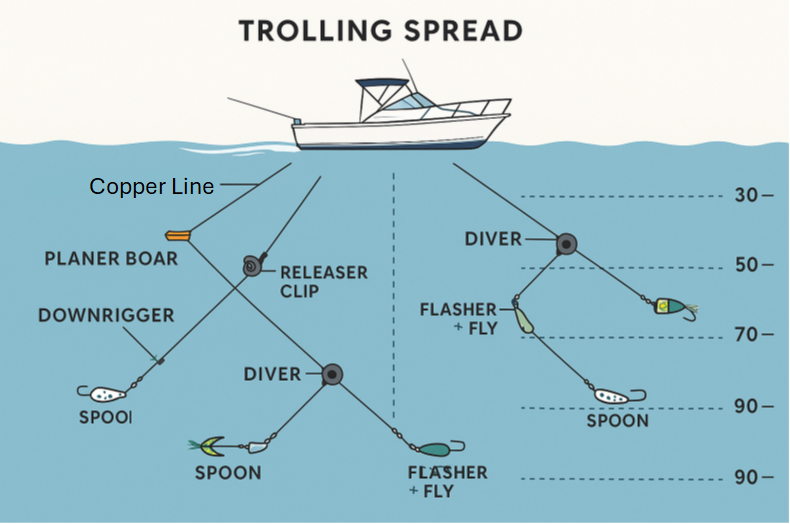
If you’ve booked a salmon fishing charter out of Saugatuck, Michigan, you’re in for an unforgettable day on the water. From the moment we leave the pier and point the bow toward deeper water, the crew is focused on one mission: putting you on fish. And while it may look like magic watching a dozen lines go out without chaos, what you’re really seeing is a refined system built around experience, technology, and three critical trolling tools: downriggers, divers, and copper lines line.
Each of these tools plays a specific role in the fishing strategy. They help us target salmon at different depths, cover a wide horizontal spread behind the boat, and maximize the chances of hooking up with Lake Michigan’s legendary kings, cohos, and steelhead. This blog post will walk you through how each setup works, when and why we use it, and what to expect when you’re on the charter. You’ll also learn some pro tips we use to stack lines, avoid tangles, and create a high-efficiency spread that’s both smart and deadly effective.

Why Multiple Tools Matter in Lake Michigan Salmon Fishing

Lake Michigan is a deep, dynamic fishery that changes dramatically throughout the year. Water temperatures, baitfish locations, light levels, and even boat traffic affect where salmon are and how they behave. To consistently catch fish, we need to cover the water column from the surface to over 100 feet deep, often simultaneously.

That’s where the trio of downriggers, divers, and copper lines line comes in.

Think of these as tools in a toolbox. Some work best in cold, deep water during late summer. Others shine in spring when fish are feeding aggressively near the surface. By combining them into one organized spread, we ensure we’re hitting the right depths at the right times, giving each bait presentation the best chance to trigger a strike.

Let’s break each tool down, starting with the workhorse of deep trolling: the downrigger.

Downriggers: Precision Depth Control

What They Are and How They Work

A downrigger is a winch system mounted on the boat, equipped with a long boom and a heavy cannonball weight (typically 8 to 12 pounds) attached to a steel cable. The fisherman attaches their main fishing line to the weight via a release clip, which holds the line in place under tension.

As the weight is lowered to a set depth—controlled via a depth counter—the bait or lure follows. When a fish strikes, the line pops free from the clip, and you’re directly connected to the fish with no added resistance. That makes for a clean, exciting fight.

When and Why We Use Them

Downriggers are essential during mid to late summer, when salmon move deeper to stay in colder water below the thermocline—often between 60 and 120 feet. Kings and cohos can be lethargic in warmer surface temps, so getting baits down to them precisely is critical.

Downriggers allow us to present lures at exact depths, monitor them on sonar, and make real-time adjustments based on fish activity. We can change depth within seconds, chase marks we see on the screen, and run lures right through thermal breaks where salmon are stacked.

Tips for Stacking Lines on a Downrigger

We sometimes “stack” multiple lines on the same downrigger cable to increase our coverage vertically. For example, we may clip one line at 60 feet and another at 45 feet. This technique lets us double up on productive areas without needing more equipment.

Stacking tips:

  • Use light-tension clips for higher baits and medium for the deeper one.
  • Stagger line lengths back to prevent tangling during a strike (e.g., 25 ft back on the top line, 15 ft back on the bottom).
  • When a fish hits the top line, we quickly clear the bottom to avoid a crossed mess.

With practice, this setup becomes smooth and efficient, and customers are often amazed at how fast we can have two lines back down after a double.

Divers: Covering the Mid-Depth Strike Zone

What They Are and How They Work

Divers, like the popular Dipsy Diver or Slide Diver, use a disc-shaped mechanism that planes outward and downward when trolled through the water. These devices attach directly to the fishing line and are adjustable based on how deep and wide you want to fish. The deeper the set number (typically 0 to 3), the farther out and down they’ll dive.

Divers are designed to pull your bait away from the boat’s path and down into the mid-depth zone. They “trip” or release from their diving angle when a fish strikes, allowing for an easier fight.

When and Why We Use Them

Divers are great for covering the mid-range depths—roughly 30 to 70 feet, depending on the diver and trolling speed. This makes them especially effective from early to mid-summer, when salmon may be suspending off bait balls or hanging in transition zones before dropping deeper.

They also let us spread our lines horizontally, widening our troll and keeping baits out of the boat’s wake. This is particularly helpful when fish are boat-shy in clear conditions or after heavy traffic.

Avoiding Tangles and Maximizing Performance

To keep divers from interfering with downriggers or other lines:

  • Use longer rods (9–10 feet) to help guide the diver away from the boat.
  • Keep diver rods set at different angles on the rod holders—steeper on inside divers, flatter on outside divers.
  • Adjust drag and trip tension correctly to match your lure’s resistance.

Divers also work extremely well when paired with flasher/fly combos or meat rigs—especially when you want to add some action to draw in big kings from the depths.

Copper Line: Deep Reach with Silent Precision

In addition to downriggers, divers, and copper lines, we often incorporate copper line into our trolling spread—especially when targeting salmon holding deeper in the water column with minimal disturbance. Copper line offers a stealthy, weight-based solution for running baits at depths of 60 to over 100 feet without the need for downriggers or divers.

Copper is denser than copper lines and sinks more effectively. A 300-foot section of copper line, for example, can get your bait down to about 75–90 feet, depending on speed and lure size. We spool copper onto large, high-capacity reels and use planer boards to spread these lines wide from the boat, avoiding the prop wash zone and increasing coverage.

Running copper takes finesse. Because it’s stiffer and more prone to kinks than other lines, we handle it carefully when deploying and retrieving. But its payoff is worth it—deep, silent presentations that are often the ticket to enticing pressured or finicky fish in warm water or after a front.

Copper lines are often paired with flashers and fly rigs, meat rigs, or spoons, depending on the day’s bite. We typically run 200-, 250-, 300-, and even 400-foot copper setups, spaced with appropriate boards and rod angles to keep lines from tangling.

On our Saugatuck charters, copper is a game-changer when the salmon are holding deep but skittish. It’s one more tool in our arsenal to help you land the big one.

When and Why We Use It

Copper lines are most effective in spring and early summer, when salmon are actively feeding in the upper layers of the water. It’s also deadly when targeting steelhead and coho near the surface.

Because it runs higher in the water, we use planer boards to pull copper lines lines out to the side of the boat. This lets us cover a wide swath of the water horizontally while avoiding prop wash and keeping the fish from spooking.

We may run 2–4 copper lines setups on a given trip—10-color, 7-color, 5-color, and even 3-color lines—each targeting a specific depth layer and spreading the baits wide.

Pro Tips for copper lines Success

  • Watch your turns. On a turn, the inside board slows down and sinks while the outside speeds up and rises. This can trigger strikes but also causes tangles if not managed properly.
  • Mix in spoons, body baits, or small flashers depending on conditions and species.
  • Use line counters on reels or marks on boards to track exactly how much line you’ve let out.

copper lines may be silent in the water, but it’s one of the most consistent producers in our spread, especially in the early morning light or after storms push fish higher in the column.

How It All Comes Together: The Spread

Here’s what a typical trolling spread might look like on our charter boat out of Saugatuck:

  • 2–4 downriggers running at 60, 80, 100, and 120 feet, with a couple of stacked lines in the 40–60 foot range.
  • 2–4 divers set to 1.5 and 3 on each side, covering 40–70 feet with large attractors or flies.
  • 4 copper lines (3-, 5-, 7-, and 10-color) on planer boards running wide and high, from 15 to 60 feet.

This setup allows us to hit multiple depth layers and maximize horizontal coverage—critical when salmon are scattered, suspended, or feeding in different zones.

When fish are concentrated, we may double up certain depths and swap in copper line or weighted steel to fine-tune presentations. But this core system works on 90% of trips and consistently puts fish in the boat.

Avoiding Tangles: The Art of Line Management

One of the biggest challenges in running this many lines is avoiding tangles, especially when fighting a fish or turning the boat.

Here’s how we manage it:

  • Stagger lines in both depth and setback (distance behind the boat).
  • Use different angles and rod holders to physically separate lines.
  • Communicate clearly when a fish hits. The crew calls out the rod (“10-color starboard!”), clears nearby lines, and ensures the angler can fight the fish clean.
  • On turns, slow and smooth is key. Avoid oversteering and monitor the speed to keep inside and outside lines balanced.

After years of experience, our crew makes this look easy, but every move has a purpose.

What You’ll Experience Aboard Our Saugatuck Salmon Charter

As a customer aboard our Lake Michigan charter boat, you’ll see this entire system in action. From the moment we set lines, you’ll witness a carefully choreographed dance of rods, reels, weights, boards, and bait. You’ll learn what we’re targeting and why—based on sonar marks, wind conditions, water temps, and time of day.

You’ll help set lines if you want, or just relax and watch the pros work. When a rod goes off, the adrenaline kicks in—and you’re on the reel fighting a salmon that might weigh 15 to 25 pounds or more.

Each trip is different, and we adjust our setup constantly. One day it might be a diver bite; the next, all the fish are hitting stacked downriggers or 5-color boards. Part of the fun is figuring out the pattern and dialing in a hot program.

Final Thoughts: Choosing the Right Setup Means More Fish and More Fun

Downriggers, divers, and copper lines aren’t just tools—they’re strategic solutions to a moving target. Lake Michigan salmon aren’t static. They move with water temps, bait schools, and light conditions. To stay on them, we use every option available to cover water intelligently.

Whether you’re a seasoned Great Lakes angler or it’s your first time on a salmon charter, understanding the “why” behind our spread will deepen your appreciation of the experience. You’ll learn what makes Lake Michigan such a rich and rewarding fishery—and why so many anglers come back year after year.

So come aboard with us out of Saugatuck, bring your cooler and your camera, and let’s put some chrome in the boat using the right tools, the right way, at the right time.

Top Trolling Techniques for Catching Lake Michigan Salmon: What to Expect on Your Saugatuck Charter Adventure

If you’re planning a salmon fishing charter on Lake Michigan out of the scenic port of Saugatuck, you’re in for an unforgettable experience. Whether you’re a seasoned angler or casting lines for the first time, one of the key techniques we use to chase down monster Kings and Coho salmon is trolling. Trolling is the gold standard for salmon fishing on Lake Michigan — and it’s more strategic than you might think.
Here’s a breakdown of the top trolling techniques we use on our charters and what you can expect to see (and catch!) when you come aboard.

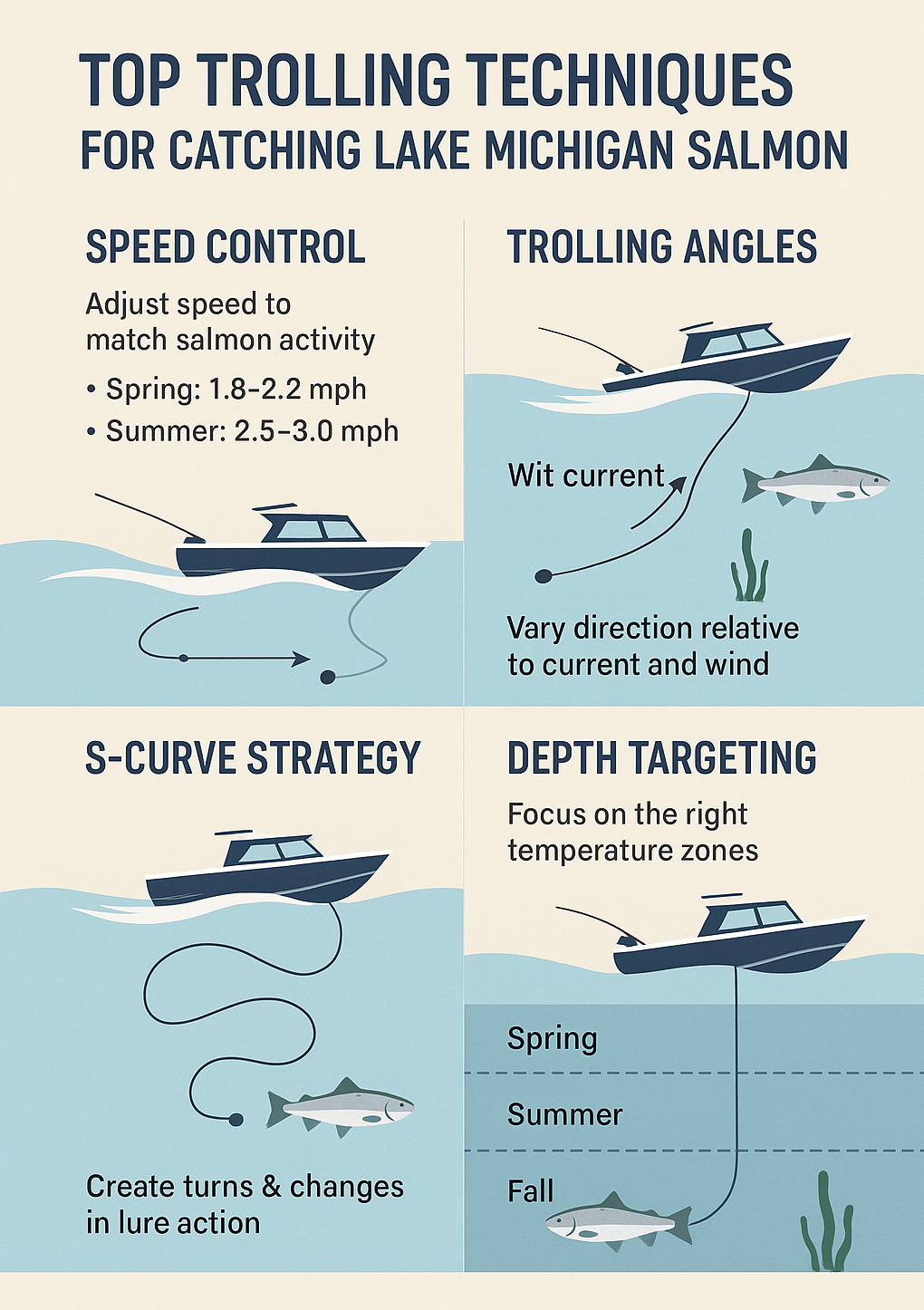
Speed Control: The Art of the Perfect Pace

Speed can make or break a trolling run. Salmon are fast, reactive predators, and our trolling speed has to match their mood.

  • In early spring, when water temperatures are cold and salmon are less aggressive, we slow down to around 1.8–2.2 mph.
  • As the water warms up in mid to late summer, we often bump up to 2.5–3.0 mph to entice more active fish.

You’ll notice that we’re constantly adjusting our speed — often by small increments — because even a change of 0.2 mph can be the difference between a quiet rod and a screaming reel.

We’ll often watch how the lures are working in the spread or use a downrigger-mounted probe to monitor speed at depth, where the salmon actually are. What feels like 2.5 mph on the surface can be much slower 50 feet down due to current.

Trolling Angles: It’s Not Always Straight Ahead

Salmon aren’t always going to chase bait head-on, which is why we don’t troll in a straight line all day. Changing our trolling direction relative to current and wind is crucial. Angling the boat:

  • With the current can keep our lures moving more slowly through the water column.
  • Against the current can add extra action to the lures.
  • Cross-current or diagonal trolling often hits the sweet spot, mimicking a wounded baitfish trying to escape.

When a rod fires, we take note of the boat’s angle at that exact moment. Repeating productive passes at that same angle often brings in more fish.

The S-Curve Strategy: Triggering Reaction Strikes

One of the most reliable trolling patterns we use is the S-curve. Instead of driving the boat in a straight line, we make slow, sweeping curves — picture the shape of a lazy “S” across the water.

Why it works:

  • The inside lures momentarily slow down during the turn.
  • The outside lures speed up and rise slightly.
  • This variation in action often triggers salmon into striking, especially those that have been following but haven’t committed yet.

On your charter, you’ll see this in action — especially during slow periods. It’s amazing how a simple boat turn can suddenly light up the rods.

Depth Targeting: Finding the Right Water Column

Salmon are temperature-sensitive and depth-driven. To be successful, we have to present lures in the exact zone they’re feeding.

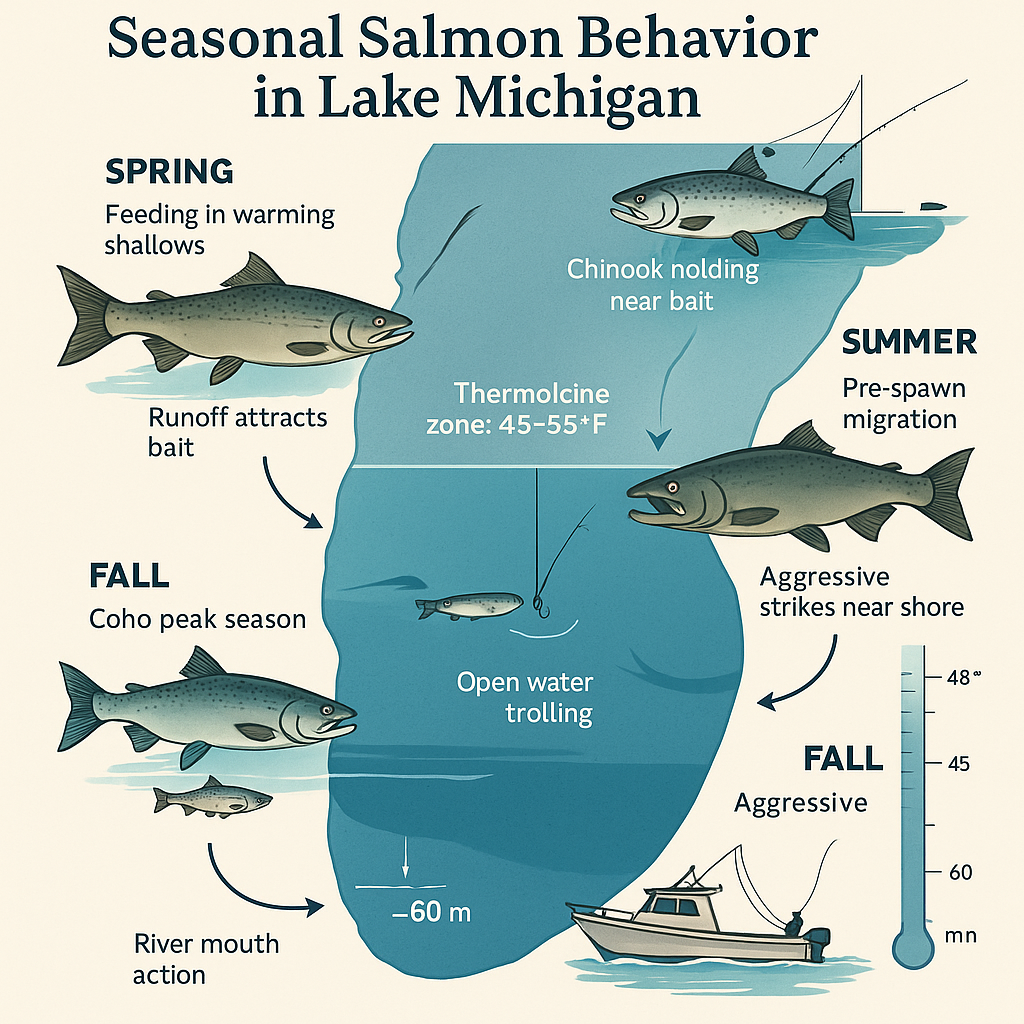
  • In spring, we often target water less than 30 feet deep, near the shoreline or river mouths, where Coho salmon and immature Kings hunt.
  • By summer, thermal layers (thermoclines) develop, and mature Kings go deep — often 60 to 100 feet down, sometimes even deeper on hot August days.
  • In fall, pre-spawn salmon stage in mid-depths, and we’ll run a wide spread to cover 20 to 80 feet and key in on patterns.

We use a combination of downriggers, dipsy divers, copper lines, and copper line to present lures at multiple depths. You’ll see your captain and crew working the rods constantly — adjusting, resetting, and fine-tuning based on fish marks on the sonar or how each rod is performing.

How These Techniques Change Through the Season

Every season on Lake Michigan offers a unique salmon-fishing experience:

  • April–May: Nearshore trolling for aggressive Coho and steelhead. Flat lines, high-speed dodgers, and bright spoons.
  • June–July: Kings move deeper. More sophisticated spreads with longer leads, flasher/fly combos, and a focus on depth control.
  • August: Trophy time. Big mature Chinook push offshore and deep. Patience, persistence, and sharp trolling technique matter most.
  • September: Staging salmon come in closer again before spawning. Surface temperatures drop, and we adjust to more erratic bite windows.

As your charter captain, we bring local knowledge and experience to these seasonal shifts — so no matter when you book, we’ll be using the most productive approach for that time of year.

Get Hooked on the Experience

When you book a salmon charter out of Saugatuck, you’re not just going fishing — you’re joining a tactical hunt across one of the Great Lakes’ richest fisheries. Every rod spread, every boat turn, and every speed adjustment is part of the strategy. And nothing beats the thrill of watching a rod slam down, drag screaming, and knowing you’ve got a Lake Michigan salmon on the other end.

Whether you’re after your first King or chasing a personal-best catch, you’ll walk away with an unforgettable story — and likely some fresh fillets too.

Ready to experience it for yourself? Book your Saugatuck salmon charter today and join us on the water. Tight lines!

Unleashing the Power of Divers for Salmon Fishing in Lake Michigan

Lake Michigan is a treasure trove for anglers seeking the thrill of salmon fishing. While downriggers have long been a popular tool, divers have emerged as an equally effective and versatile method for targeting salmon in this vast freshwater lake. In this comprehensive guide, we will delve into the art of using divers to enhance your salmon fishing experience on Lake Michigan. By understanding the types of divers available, selecting the right gear, and employing effective techniques, you can increase your chances of landing the prized salmon.

Understanding Divers

Divers, also known as diving planers, are specialized devices designed to dive deep into the water column while towing your bait or lure behind. They are typically made of plastic or metal and feature an adjustable mechanism that determines the depth at which they dive. Divers work by creating drag, which pulls them downward, allowing your bait to reach greater depths than traditional trolling methods.

Selecting the Right Divers

Choosing the appropriate divers is crucial for a successful salmon fishing expedition on Lake Michigan. There are various types of divers available, including inline divers, jet divers, and diving planers. Inline divers, such as the popular Dipsy Divers, are versatile and easy to use. Jet divers, like the Luhr-Jensen Jet Diver, are excellent for targeting specific depths. Diving planers, such as the Off Shore Tackle OR-12, are ideal for precise depth control. Consider the depth you wish to fish, the size of your target salmon, and the trolling speed when selecting the right divers for your setup.

Preparing Your Gear

To effectively use divers, ensure your fishing rod, reel, and line are suitable for salmon fishing on Lake Michigan. Opt for a medium-heavy or heavy-action rod capable of handling the weight and fight of salmon. Pair it with a high-capacity reel equipped with a smooth drag system. Spool your reel with a high-quality monofilament or braided line, ensuring it has the appropriate strength to withstand the challenges posed by salmon.

Setting Up the Divers

Begin by attaching the diver to your main fishing line using a high-quality snap or swivel. Ensure the connection is secure to prevent any mishaps during the fishing process. Adjust the tension on the diver according to the manufacturer’s instructions and the desired diving depth. Consider the prevailing conditions, such as water temperature and wind direction, which may affect the diving performance. Additionally, you can experiment with the distance between the diver and your bait to optimize your presentation.

Deploying and Presenting Your Bait

Once your divers are properly set up, attach your chosen bait or lure to a leader line and connect it to the diver. Begin trolling at a slow to moderate speed, typically around 2 to 3 miles per hour, allowing the divers to dive to the desired depth. Pay attention to your rod tips for any signs of a strike, as salmon are known to hit aggressively. Experiment with different colors, sizes, and types of bait or lures to entice the salmon to bite.

Fine-Tuning Techniques and Tips

To maximize your success with divers, it’s important to fine-tune your techniques. Vary the distance between the divers and your bait to cover different depths and increase your chances of attracting salmon. Adjust the tension on the divers to fine-tune their diving behavior and presentation. Use a depth finder or fish finder to locate productive areas, such as drop-offs, shoals, or structure, where salmon are likely to congregate. Always be prepared for sudden strikes by keeping……………..

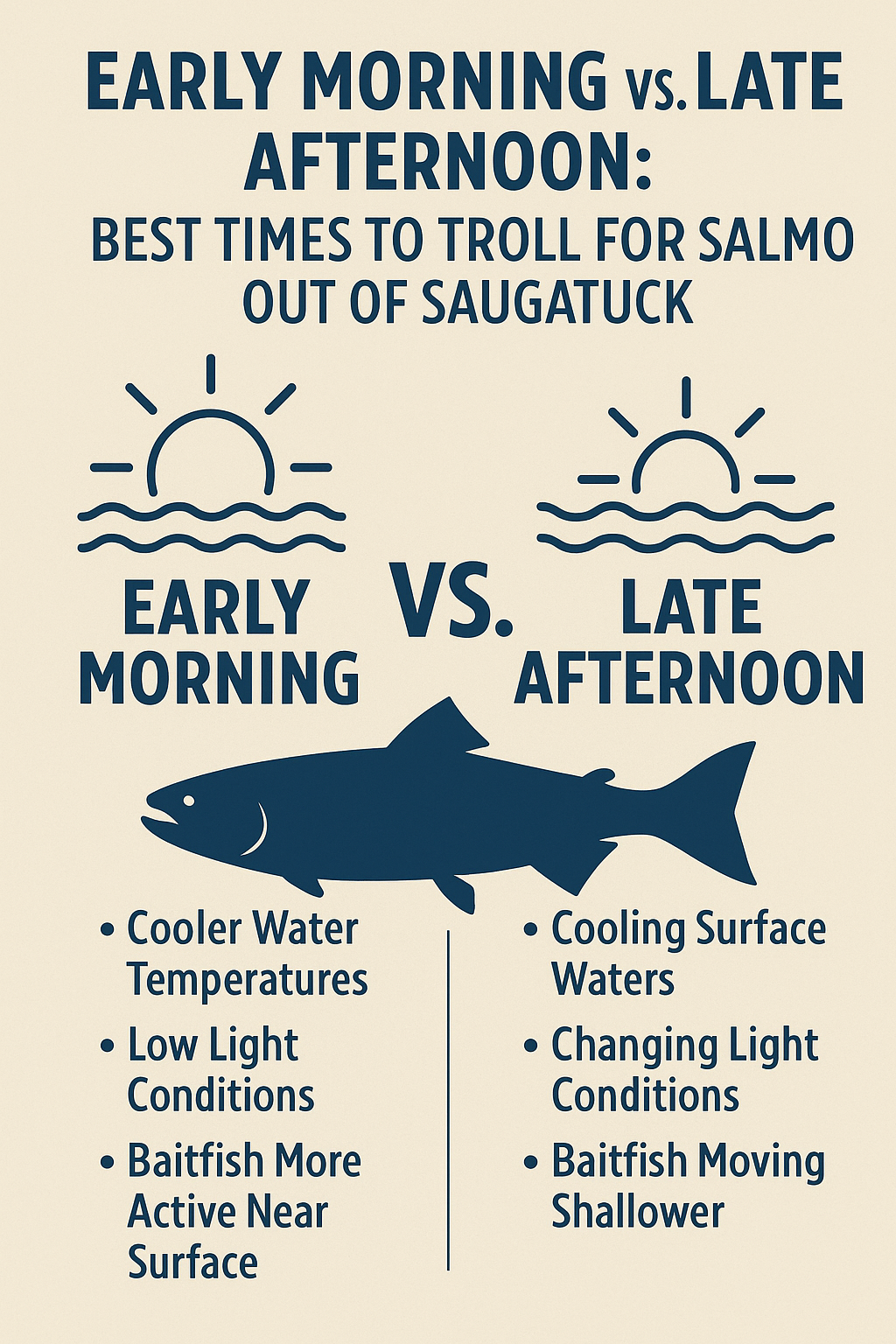
Early Morning vs. Late Afternoon: Best Times to Troll for Salmon Out of Saugatuck

If you’ve ever dreamed of landing a trophy salmon on the pristine waters of Lake Michigan, especially out of the charming port of Saugatuck, you know timing is everything. As a seasoned charter fisherman, I often get asked: When is the best time to troll for salmon—early morning or late afternoon? Both have their advantages and quirks, shaped by salmon feeding behavior, water temperature shifts, and the unique light conditions of Lake Michigan’s big waters.

In this post, I’ll break down the science and the experience behind these two prime fishing windows so you can decide the best time to plan your trip for peak success.

Understanding Salmon Feeding Behavior on Lake Michigan

Before we dive into the specific time-of-day details, it’s essential to understand the feeding patterns of the main salmon species we target here: Chinook (King) Salmon and Coho Salmon. Both species are opportunistic feeders that follow the movements of their prey—primarily alewives, smelt, and other baitfish.

Why Time of Day Matters

Salmon feeding activity is highly influenced by:

  • Light conditions
  • Water temperature
  • Baitfish movement

These factors shift throughout the day, creating windows when salmon are actively hunting or resting.

Early Morning Trolling: The Dawn Advantage

What Makes Early Morning Special?

Early morning trolling, typically from sunrise until about 10 a.m., is a classic favorite among anglers for a good reason. The cool, low-light conditions at dawn trigger a natural feeding frenzy among salmon. Here’s why:

1. Cooler Water Temperatures

During the night, surface waters cool down significantly. As the sun rises, the water temperature starts to increase but often remains in the salmon’s preferred range of about 50 to 60°F during early morning hours.

Salmon are cold-water fish, and they thrive in cooler temperatures. Early morning waters offer the perfect comfort zone, which often makes salmon more active and willing to chase bait.

2. Low Light Conditions

The low-angle sunlight and dim lighting of dawn provide salmon with a stealth advantage. They use their excellent vision to ambush baitfish that are also more active near the surface during low light.

This contrast helps salmon feel more secure hunting near the top of the water column, which is why trolling with shallow-running lures or flashers during early morning can be incredibly productive.

3. Baitfish Activity

Many baitfish species follow a daily vertical migration pattern, moving toward the surface at dawn to feed on plankton and insects stirred up by the increasing light. Salmon track this movement closely.

Because the baitfish are near the surface and active, salmon follow, creating prime feeding opportunities.

Early Morning Trolling Tips for Salmon Out of Saugatuck

  • Use shallow-running lures: Since salmon are feeding higher in the water column, use spoons, flasher-fly combos, or plugs set to run around 10-20 feet deep.
  • Start trolling right at first light: The bite often heats up quickly at sunrise and can slow as the sun rises higher.
  • Focus on the thermocline edge: Early morning is a great time to locate the thermocline (the temperature layer that separates warmer surface water from cooler deep water). Salmon often patrol the edges, so target those depth transitions.
  • Keep your trolling speed steady: Around 2.0-2.5 mph is ideal to entice active salmon without spooking them.

Late Afternoon Trolling: The Evening Surge

Why Late Afternoon is Another Prime Time

Late afternoon fishing, roughly from 3 p.m. until sunset, offers another excellent window to troll for salmon. While the environment changes throughout the day, salmon often show a resurgence of feeding activity in these hours.

Here’s why:

1. Cooling Surface Waters

After the heat of midday, surface water temperatures begin to cool again in the late afternoon. This cooling effect often triggers salmon to move upward from the depths to feed actively once more.

2. Changing Light Conditions

Similar to early morning, the lower angle and softer light of the late afternoon create ideal conditions for salmon to hunt near the surface. The fading light reduces glare and improves salmon’s ability to spot baitfish, encouraging feeding behavior.

3. Baitfish Movement and Behavior

Baitfish, like alewives, tend to move shallower in the cooler, dimmer light, making them more vulnerable targets. Salmon take advantage of this predictable behavior, increasing their feeding activity.

Late Afternoon Trolling Tips for Salmon Out of Saugatuck

  • Go deeper if water temps are warm: Salmon often adjust depth to stay within their preferred temperatures. Use downriggers or lead-core lines to get your lures down to 40-80 feet depending on the season and water temp.
  • Switch up lure colors: As light fades, try bright or reflective lures that catch and reflect the ambient light to attract salmon.
  • Adjust trolling speed: Slower trolling speeds (1.5-2.0 mph) can entice salmon during less active feeding periods.
  • Look for structure: Salmon often patrol near drop-offs, humps, and underwater ledges during late afternoon. Use your GPS to mark these hotspots.

Comparing Early Morning and Late Afternoon: Which is Better?

The honest answer: both early morning and late afternoon can produce excellent results — but conditions and salmon behavior vary by season, weather, and lake conditions.

Here’s a breakdown of pros and cons for each time window to help you decide:

Factor Early Morning Late Afternoon
Water Temperature Cooler, more comfortable for salmon Cooling after peak heat, good activity
Light Conditions Low light, excellent for surface strikes Low light, reflective lures work well
Salmon Feeding Usually a strong feeding window Often a second feeding surge
Baitfish Behavior Near surface, active Moving shallower again
Typical Depth Shallow to mid-depth Mid to deep depending on temps
Fishing Pressure Lower, fewer boats early Can be higher as more anglers join

How Seasonal Changes Affect Your Best Time to Troll

The best time to troll can also shift with the season:

Spring and Early Summer (May – Early July)

  • Water temps are generally cooler throughout the day.
  • Salmon tend to feed actively during early morning and remain active longer into the afternoon.
  • Early morning trips are often very productive as salmon adjust from cold winter depths.

Mid to Late Summer (July – August)

  • Surface waters warm significantly during the day.
  • Salmon often move deeper during midday and early afternoon to avoid warmer temperatures.
  • Late afternoon can be better as the water cools down, bringing salmon back toward the surface.
  • Early morning still offers good shallow feeding before the sun warms the lake.

Fall (September – October)

  • Water temperatures start cooling overall.
  • Salmon become more aggressive feeders, especially before their spawning runs.
  • Both early morning and late afternoon fishing can be fantastic, with salmon chasing bait aggressively near the surface.
  • Late afternoon trips may catch the “last bite” before nightfall.

What You Can Expect on Your Saugatuck Charter Trip

When you book a salmon trolling charter out of Saugatuck, here’s a taste of what you’ll experience during these prime fishing times:

Early Morning Experience

  • Setting out before dawn: There’s something magical about pushing off from the dock as the sky lightens, the water still calm, and the world quiet except for the hum of the boat motor.
  • Watching the sunrise over Lake Michigan: The early morning light plays off the waves, and the cool air feels refreshing.
  • The thrill of first strikes: The bite often comes fast and furious in early morning—reels screaming, lines tightening as salmon chase your lures.
  • Less boat traffic: Early risers tend to have the water more to themselves, which means less disturbance and better conditions.

Late Afternoon Experience

  • Relaxed pace after a busy day: You’ll head out when the sun begins to lower, the lake breezes cool off, and the golden hour casts long shadows.
  • Beautiful lighting for photos: The softer light of late afternoon is perfect for snapping pictures of your catch and the stunning lake scenery.
  • Active fish returning to feed: Salmon are often aggressive in these hours, giving you a great shot at multiple bites.
  • Social atmosphere: More boats may be out, so you can enjoy the camaraderie with other anglers while still focusing on fishing.

Final Recommendations: When to Hit the Water for Peak Success

If you’re looking to maximize your chances for a trophy salmon catch out of Saugatuck, here’s my advice:

  • Choose early morning trips if:
    • You prefer cooler temperatures and calm water
    • You want to enjoy peaceful solitude on the lake
    • You want to target salmon feeding near the surface
    • You want to experience the iconic Lake Michigan sunrise
  • Choose late afternoon trips if:
    • You prefer milder temperatures after a warm day
    • You want to take advantage of a second feeding surge
    • You’re prepared to troll deeper and use varied lure techniques
    • You enjoy the social vibe of a busier time on the water

Pro Tips for Both Times of Day

Regardless of when you choose to fish, these tips will help:

  • Pay attention to weather and lake conditions: Wind, cloud cover, and barometric pressure can all affect salmon feeding times.
  • Be flexible and ready to adjust: Salmon can be unpredictable, so changing trolling depths and speeds can make all the difference.
  • Bring a variety of lures: Different colors and styles work better depending on light conditions and fish mood.
  • Trust your guide’s experience: Local captains know the nuances of Lake Michigan’s salmon runs and will adjust tactics to give you the best shot.

Trolling for salmon out of Saugatuck on Lake Michigan is an unforgettable experience, and choosing the best time to fish can greatly increase your chances of success. Early mornings bring cooler water, low light, and active surface feeding, while late afternoons offer another prime feeding window as water cools and salmon resume their chase.

Whether you prefer the peaceful serenity of dawn or the dynamic energy of the evening bite, both times offer unique advantages and memorable fishing moments. When you join us on a charter trip, you’ll learn firsthand how to read the lake, interpret salmon behavior, and make the most of your time on the water.

So pack your gear, get ready for action, and let’s hit the water in Saugatuck—because salmon fishing here is about timing, technique, and a bit of Lake Michigan magic.

Tight lines!

The Best Months for Salmon Fishing Out of Saugatuck—and Why

If you’re considering booking a charter salmon fishing trip on Lake Michigan out of Saugatuck, Michigan, one of the most common questions you’ll ask is: When is the best time to fish? The short answer? There’s great salmon fishing to be had from April through September—but the species you’ll target, the techniques you’ll use, and even how deep you’ll be trolling will evolve throughout the season.

At our Saugatuck charter operation, we fish all season long and adapt our strategies as conditions change. In this post, we’ll walk you through the best months for salmon fishing, break down what’s biting when, and explain how our trolling methods evolve through spring, summer, and early fall.

April: Cold Water, Coho Action

As Lake Michigan thaws in early spring, the action begins in earnest. April marks the unofficial start of the salmon season, and while water temps are still frigid (often in the 40s), one species loves these early season conditions: coho salmon.

What to Expect

Coho are aggressive feeders and tend to school in the shallower, warming waters near shore. Out of Saugatuck, we often find them in 10 to 40 feet of water, typically south of the pier heads or just outside the river mouth.

This is also a time when brown trout and lake trout may be caught while targeting coho, adding variety to your cooler.

Trolling Techniques

Trolling speeds are slower—around 2.0 to 2.3 mph—because of the cold water. We often run small orange or red spoons, stickbaits, and thin trolling flies behind planer boards to spread out the presentation. Short lead cores or even flat lines work well this time of year, and it’s not unusual to have double or triple hookups when the cohos are thick.

May: Mixed Bag and Moving Offshore

As May rolls in, water temperatures slowly rise, and more of Lake Michigan’s sport fishery comes to life. This is when the kings start to show up, mixing with coho, steelhead, and lake trout.

What to Expect

By mid-May, the coho salmon start moving deeper, and king salmon (Chinook) begin appearing in larger numbers, particularly on warmer years. We’ll troll from 40 to 100 feet of water depending on conditions, and start seeing more diversity in the catch.

This is also when steelhead start to cruise the top of the water column, offering acrobatic fights that make them fan favorites.

Trolling Techniques

We begin incorporating more lead core and copper lines to reach deeper depths. Downriggers and divers come into play as we start targeting mid-water fish. Larger spoons, meat rigs, and flasher/fly combos start becoming effective, especially for kings.

Planer boards are still essential, but spreads become more complex as we cover multiple depths. Speed can be increased slightly—around 2.2 to 2.6 mph.

June: Kings Are Here

June is a transition month where things really start to heat up—literally and figuratively. Surface temps climb into the 50s and 60s, and king salmon begin to dominate our catches.

What to Expect

June can bring some of the best big-fish action of the season. Chinook in the 10-20 lb range become more common, with some bruisers pushing past 25 pounds. You’ll also still catch a mix of steelhead and coho, with the occasional lake trout near bottom.

Thermoclines begin to form—this is the point in the water column where temperature drops rapidly and where salmon often stack. Locating the thermocline becomes key to success.

Trolling Techniques

This is when our full spread gets serious. We deploy a variety of tools—downriggers, Dipsy divers, long lead core, copper lines, and deep-set planer boards. Flasher/fly combinations in green, blue, and chrome shades dominate, though spoons and meat rigs still work well, especially for kings.

We start fishing in the 80-150 foot depth range, and focus on thermocline depth—usually 50 to 80 feet down.

July: Peak Salmon Season

July is when king salmon fishing peaks, and if you’re looking for action, size, and consistent limits, this is the month you don’t want to miss.

What to Expect

By mid-July, mature Chinook are feeding heavily as they prepare for their August/September spawning run. We fish deeper water (120–180+ feet) but often target depths from 60 to 100 feet down.

Steelhead and coho are still around but tend to stay higher in the water column or in slightly warmer water. Lake trout, meanwhile, hang near bottom and offer steady action for those who want to bottom bounce.

Trolling Techniques

This is big-boy trolling season. We use full 300+ foot copper lines, 10-color lead cores, deep Dipsy divers, and downriggers set 80-100+ feet deep.

Speed and depth control become crucial, and we use temperature probes and sonar to locate the thermocline precisely. Bait selection leans toward meat rigs and large flasher/fly combos in white, green, and UV patterns. Scent attractants become helpful for enticing strikes from wary salmon.

A big king will scream line off a reel and test your arms and your gear. Expect battles that last several minutes—and smiles that last much longer.

August: Monster Kings and Early River Moves

August is big fish month. The kings you’ll catch now are fully mature and on the move toward spawning tributaries—including the Kalamazoo River right here in Saugatuck.

What to Expect

This is the best month to catch your biggest Chinook salmon. Fish in the 20-30 lb range are common, with occasional 35+ lb trophies landed each year. Some salmon begin staging near the river mouth, while others are still feeding out in deeper water.

Steelhead and lake trout are still present but play second fiddle to the kings.

Trolling Techniques

In early August, we’re still fishing offshore in 100–160 feet of water. By late August, we often move shallower—50 to 100 feet—especially near the river mouth or pier heads. This is staging season, and salmon become more aggressive but also more finicky.

Meat rigs really shine now, often fished slowly behind big flashers. Glow patterns work well early in the morning or on overcast days. Wire Dipsy divers, deep copper lines, and riggers are the workhorses of August.

The fights are intense. Hook up with a staging king and prepare for a 15-minute tug-of-war.

September: Shoreline Fireworks

September fishing out of Saugatuck is unique—many kings enter the river system to spawn, but many still linger just offshore. This can lead to phenomenal pierhead trolling, especially for customers who prefer shorter boat rides but still want action.

What to Expect

This is the best month for nearshore, high-intensity king salmon action. The fish are darker in color and may not be as prime for eating, but they fight harder than ever as they prepare to spawn. Most are males, and they are aggressive.

Steelhead start making a bit of a comeback, and lake trout are still available in deeper water.

Trolling Techniques

Trolling right outside the river mouth or along the shoreline becomes the main tactic. We often fish in just 20 to 60 feet of water using short lead cores, divers, and flat lines.

Bright spoons, J-plugs, and glow baits excel now, particularly early in the morning or at dusk. Troll speeds slow down again, often around 2.0 mph or slower.

This is also a great time for new anglers or families, as the short runs mean more time fishing and less time cruising.

October: End of the Run

While our charter season typically winds down in September, there can still be fishable action into October—particularly for those who want to target steelhead or chase a few late kings.

What to Expect

Most Chinook salmon have entered the rivers or are finishing their spawn. The pierheads and river mouth may still offer some bites, but many of the kings are spent.

However, fall steelhead (also known as “chromers”) begin to return to shoreline areas, and this can lead to exciting action. These fish are silver-bright, aggressive, and aerobatic.

Trolling Techniques

Light tackle trolling with small spoons or crankbaits near the surface works well, especially mid-morning when the sun warms the upper layers. It’s also a great time to use planer boards for wide, stealthy presentations.

Putting It All Together: When Should You Book?

Here’s a summary table of what’s best and when:

Month Primary Species Best For
April Coho Salmon, Browns Early season action, shallow trolling
May Coho, Kings, Steelhead Mixed bag, deeper waters, active bites
June Kings, Steelhead, Lakers Thermocline sets up, bigger fish show up
July Chinook Kings (Peak) Heavy limits, deep water, big fish battles
August Chinook Kings (Largest) Trophies, staging fish, intense fights
September Kings, Steelhead Nearshore trolling, short trips, high action
October Steelhead Late runs, silver bullets, bonus fishing


What You’ll Experience on a Saugatuck Salmon Charter

When you book a salmon charter with us out of Saugatuck, here’s what you can expect:

  • All gear provided: Rods, reels, tackle, and bait are all included. 
  • Comfortable vessel: Our charter boat is fully equipped for trolling, safety, and comfort. 
  • Experienced captain and crew: We know these waters inside and out. 
  • Hands-on fishing: Whether you’re a seasoned angler or a complete beginner, we’ll get you into the action and show you the ropes. 
  • Cleaning and bagging: At the end of the trip, we’ll clean and bag your catch so you can take it home (or to the nearest grill).

Each month offers its own unique experience for salmon fishing out of Saugatuck. Whether you’re chasing spring coho, summer kings, or staging bruisers in late August, there’s always something biting on Lake Michigan.

The key is understanding how the fish—and the lake—change with the seasons. And that’s exactly what we do every day on our charters: read the water, track the thermocline, adjust the spread, and get our guests on the fish.

Ready to experience the best of Lake Michigan salmon fishing? Book your charter today and let’s put some fish in the box.